


The cold brew coffee concentrate recipe is the one coffee skill worth mastering if you drink iced coffee more than twice a week — because making your own concentrate at home costs a fraction of what you pay at a café, stores in the fridge for a full week, and tastes noticeably smoother and less acidic than anything you will pour over ice from a hot brew. Dana here, and I have been making cold brew concentrate every single summer for years. The first time I figured out the correct grind size and ratio, I genuinely never went back to buying it. Two ingredients — coarse ground coffee and filtered water — and about 18 hours of patience is all it takes.
What makes this cold brew coffee concentrate guide different from most is the depth: you will get the exact coffee-to-water ratio that produces a balanced, strong concentrate (not bitter, not weak), a full grind size explanation, step-by-step photo instructions for the standard mason jar method, the French press variation, the hot bloom technique for a bolder flavor, and a complete dilution and serving guide. Whether you are a first-timer who has never made cold brew or someone who keeps getting muddy or bitter results, this recipe covers every variable that matters and gives you the knowledge to troubleshoot anything that goes wrong.
How to Make Cold Brew Coffee Concentrate (with Photos)
Making cold brew coffee concentrate at home is genuinely one of the simplest coffee techniques that exists — and one of the most rewarding. The process has four steps: combine, brew, filter, and serve. No heat involved, no special skills required, and the only time investment is the 18-hour steep, which happens passively in your refrigerator overnight while you do absolutely nothing.
The result is a thick, deeply flavored liquid that is not meant to be drunk straight. You dilute it before serving — usually at a 1:2 ratio of concentrate to water, milk, or a combination. Because cold water extracts coffee differently than hot water, pulling flavors more slowly and leaving behind many of the bitter, acidic compounds that hot brewing releases, the finished concentrate tastes smooth, naturally sweet, and noticeably less harsh than any hot-brewed coffee you cool down over ice.
Basic Method — Step by Step:
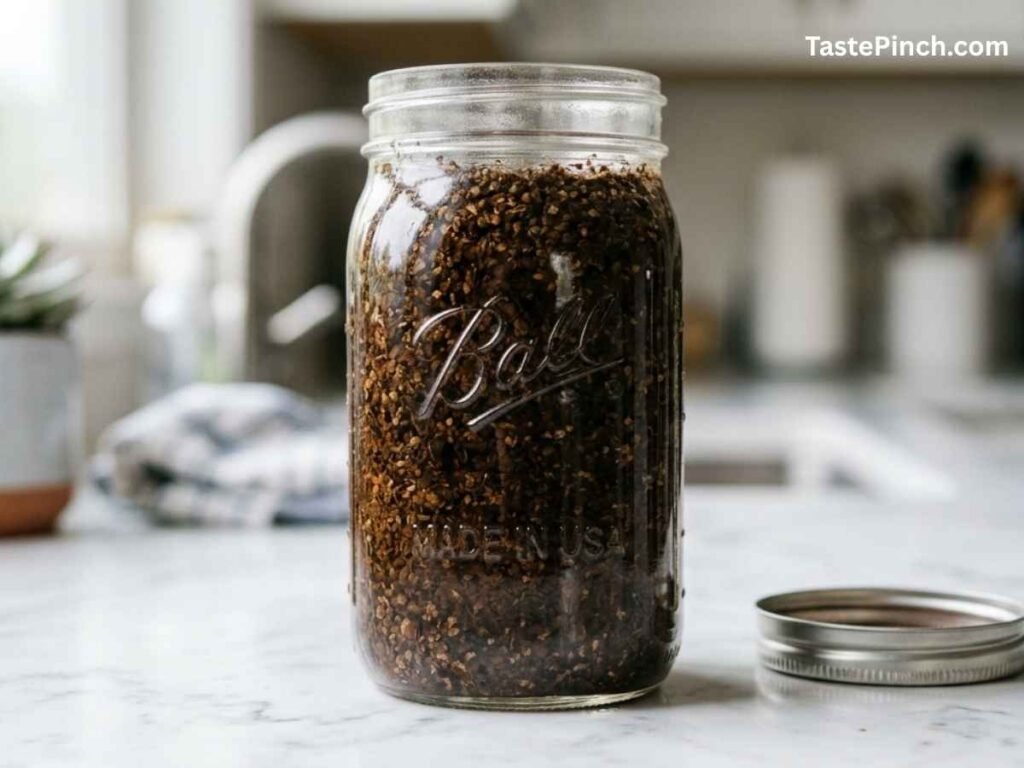
Step 1 — Combine Add 75 grams (about ¾ cup) of medium-coarse ground coffee to a large mason jar or airtight container. Pour in 3 cups (710 ml) of cold filtered water. Stir thoroughly with a long spoon or whisk to ensure no dry pockets of coffee remain. Every ground should be fully saturated.
Step 2 — Brew Seal the jar tightly with a lid. Place in the refrigerator. Steep for 18 hours. You can also brew at room temperature for 12 hours if you prefer, though refrigerator brewing produces a cleaner, slightly less acidic result. Keep the brewing time between 12 and 24 hours — under 12 hours and the extraction is incomplete; over 24 hours and the concentrate starts to taste muddy.
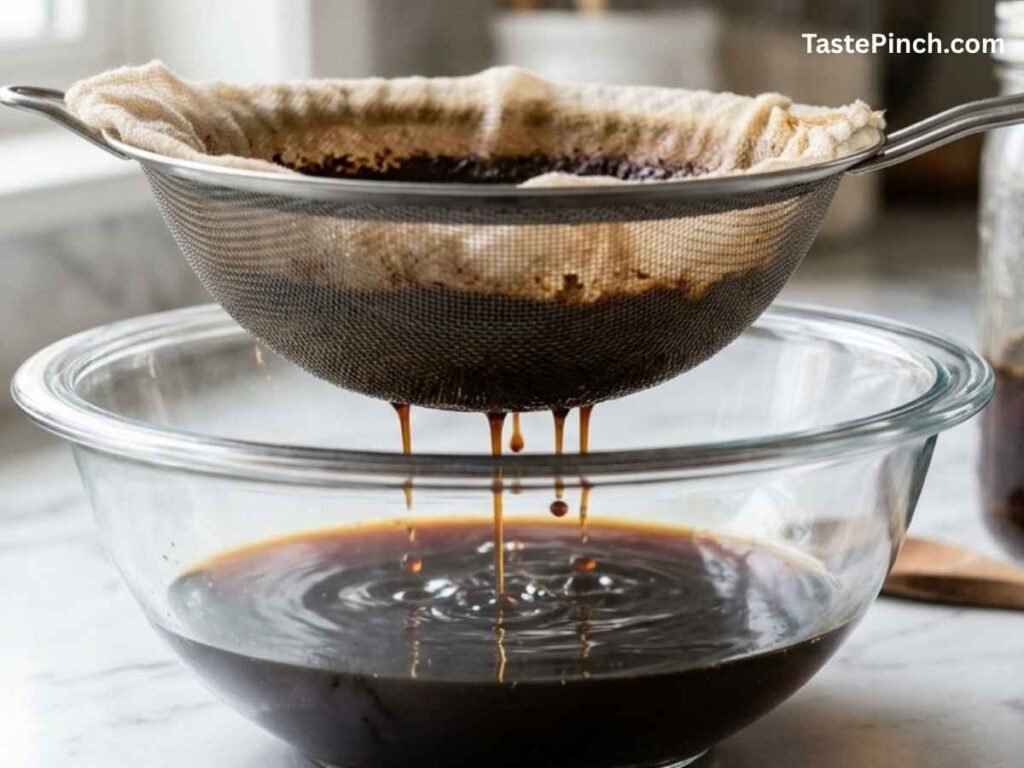
Step 3 — Filter Place a nut milk bag or cheesecloth inside a fine-mesh sieve set over a large bowl. Slowly pour the cold brew mixture through it. For the clearest, cleanest concentrate, filter a second time — the second pass removes fine particles that cause cloudiness or a gritty mouthfeel. Do not use a standard paper coffee filter for this step — it is too dense, clogs immediately, and turns a five-minute job into a half-hour frustration.
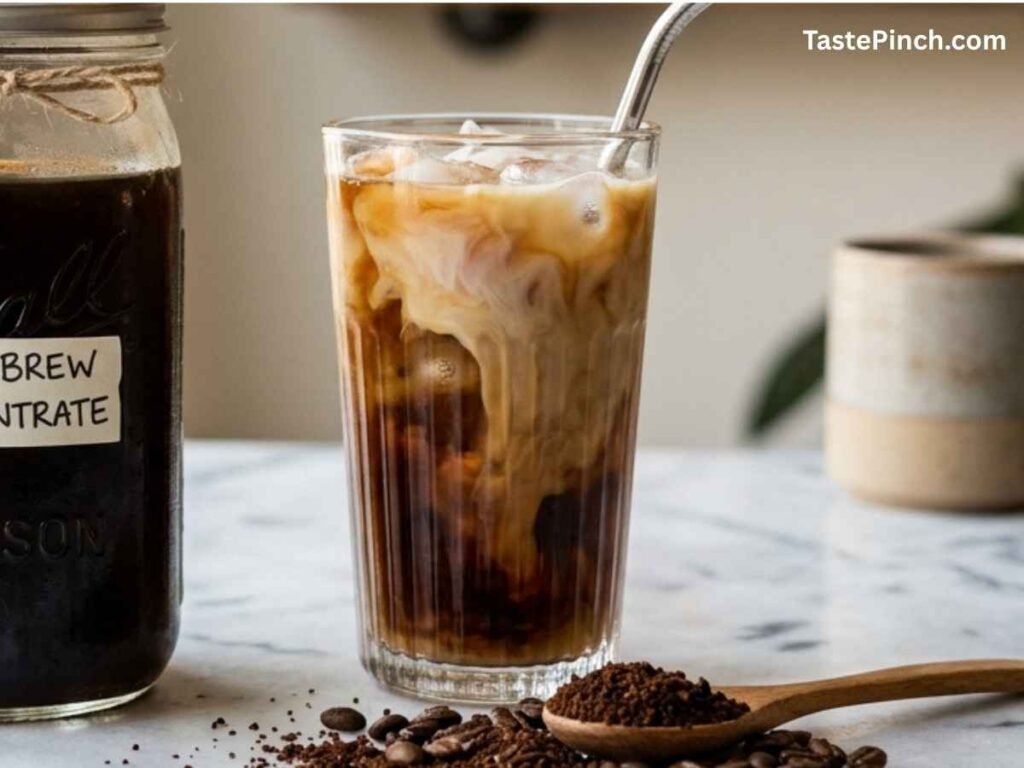
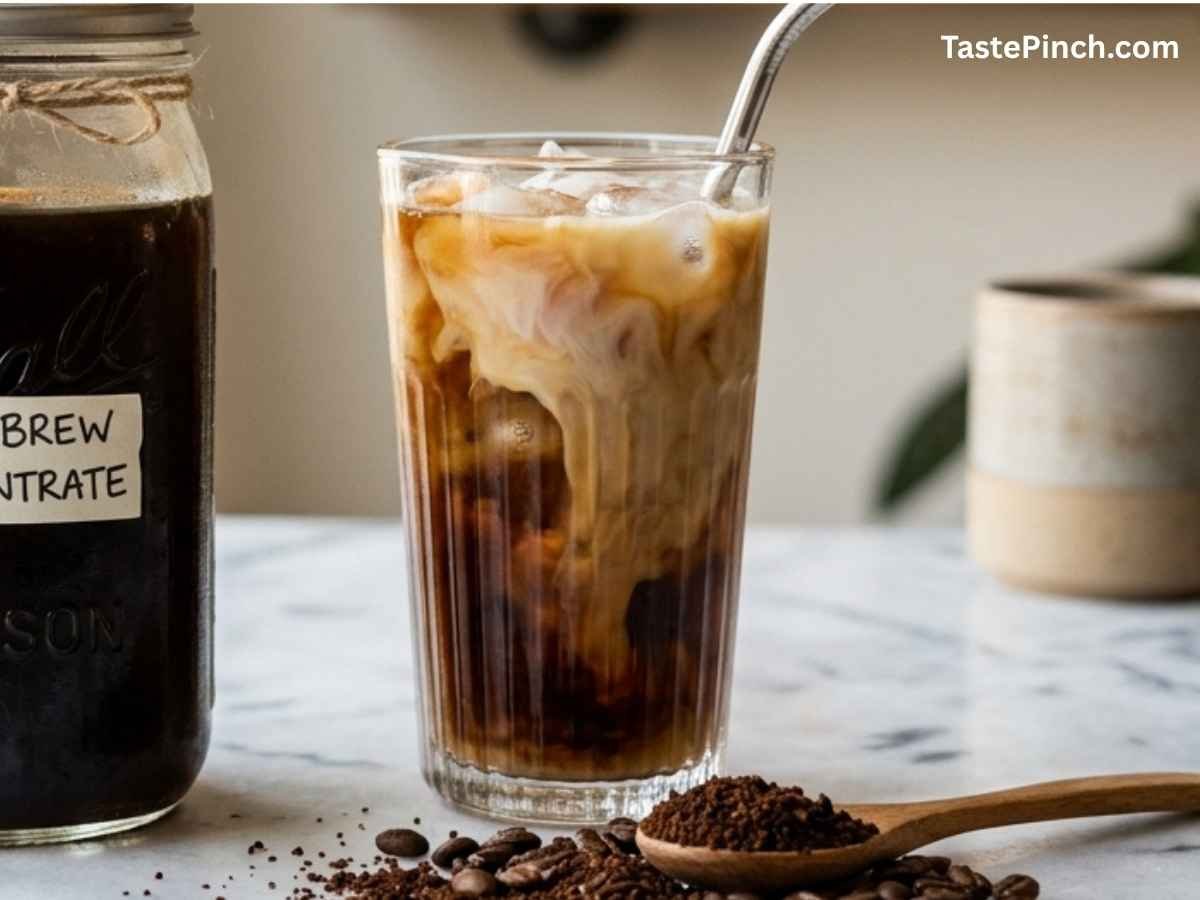
Step 4 — Store and Serve Transfer the filtered concentrate to a clean mason jar or airtight bottle. Store in the refrigerator for up to one week. When serving, dilute 1 part concentrate to 2 parts cold water, milk, oat milk, or creamer of choice. Add ice and serve immediately.
Cold Brew Coffee Concentrate Recipe – Perfect Ratio
Cold Brew Coffee Concentrate Ingredients
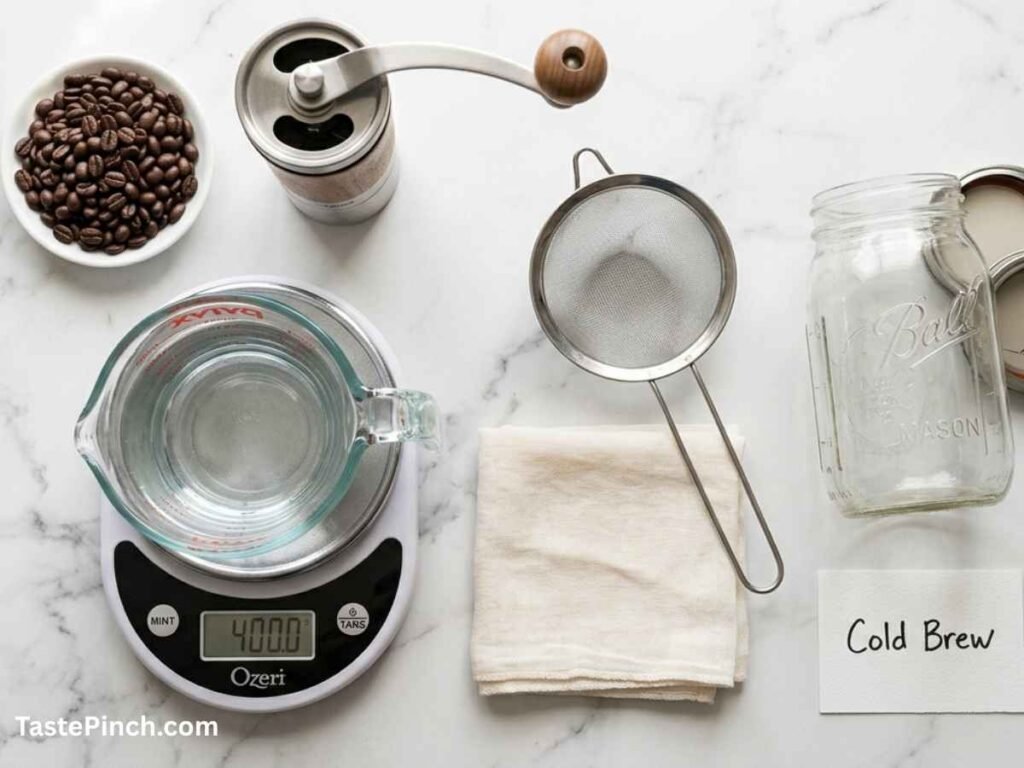
Cold Brew Coffee Concentrate Recipe’s Ingredients and Equipments.
Cold brew coffee concentrate uses exactly two ingredients — and the quality of both directly determines the quality of what ends up in your glass. This is a recipe where there is nowhere to hide. Simple recipes with few ingredients always magnify the quality of what goes into them.
Ingredient 1 — Coffee Beans (75 grams / ¾ cup ground) Use whole beans and grind them fresh. Medium or dark roast works best for cold brew concentrate because these roasts retain a strong, full-bodied flavor even through the slow, cold extraction process. Light roasts tend to produce a thin, slightly sour result in cold brew because they rely more on the brightness of hot water extraction to develop their best characteristics. Fresh beans matter enormously — use beans roasted within the past four to six weeks. Stale beans that have lost their soluble aromatic compounds through oxidation produce a flat, one-dimensional concentrate that no ratio or steep time will fix.
Best brands widely available in the US:
- Gevalia House Blend Medium Roast — full-bodied, balanced, consistent
- Stumptown Hair Bender — complex, fruity, excellent cold brew results
- Chameleon Cold Brew Ground Coffee — specifically designed for cold brew
- Lifeboost Low Acid Cold Brew Coffee — ideal for those sensitive to acidity
Ingredient 2 — Filtered Water (3 cups / 710 ml) Filtered water makes a more noticeable difference in cold beverages than in hot ones — because our taste buds register flavors in cold liquids more strongly than in warm ones. Chlorine and mineral off-flavors from tap water that disappear in hot coffee are clearly detectable in cold brew. Use filtered water for the concentrate and you will immediately taste the difference in the final cup. A standard pitcher filter (Brita or similar) is completely sufficient — no need for anything specialized.
What’s the Best Coffee Grind Size to Make Cold Brew Coffee Concentrate?
Grind size is the single most important variable in cold brew coffee concentrate — more important than brew time, more important than which brand of coffee you use. Get the grind size wrong and no other variable can compensate for it. This is the section most home cold brew guides gloss over, and it is exactly where most bad batches begin.
The correct grind size for cold brew concentrate is medium-coarse — slightly coarser than what you would use for a French press, and significantly coarser than drip coffee or espresso. The visual reference that works best: medium-coarse ground coffee should look like rough raw sugar or coarse sea salt. Each particle should be clearly visible and distinct — not a fine powder, not a sandy texture, but actual individual granules with some size to them.
Why grind size matters so much:
Cold brew steeps for 12 to 24 hours — dramatically longer than any hot brewing method. During that long steep, the water is continuously extracting flavor compounds from every exposed surface of every coffee particle. A fine grind exposes dramatically more surface area than a coarse grind. In a hot brew that takes 2 to 4 minutes, fine grind is exactly what you want. In an 18-hour cold steep, fine grind means the water extracts everything — including the harsh, bitter compounds that a coarse grind leaves behind. The result is over-extracted, bitter, astringent concentrate that no amount of dilution fully fixes.
Grind size troubleshooting:
| Problem | Most Likely Cause | Fix |
|---|---|---|
| Bitter, harsh concentrate | Grind too fine | Coarsen grind, reduce steep time |
| Weak, thin concentrate | Grind too coarse OR steep too short | Shorten grind slightly OR extend steep |
| Cloudy, silty concentrate | Fine particles passing through filter | Filter twice through cheesecloth |
| Sludge at bottom of jar | Fines in the grind | Use a burr grinder for consistent coarse grind |
| Slow, clogging filter | Grind too fine | Coarsen grind significantly |
Use a burr grinder, not a blade grinder. Blade grinders chop coffee unevenly, producing a mix of very fine powder and larger chunks in the same batch. This inconsistency means some particles over-extract while others under-extract, producing a muddy, unpredictable result. A burr grinder — even an affordable hand burr grinder — produces a consistent particle size that makes every batch predictable and repeatable.
What’s the Correct Coffee to Water Ratio for Cold Brew Coffee Concentrate?
The correct coffee-to-water ratio for cold brew coffee concentrate is 1:4 to 1:5 by weight — meaning 1 gram of coffee for every 4 to 5 grams (or milliliters) of water. This produces a strong concentrate that you dilute before drinking. The specific recipe in this guide uses 25 grams of ground coffee per 1 cup (237 ml) of water, which is a ratio of approximately 1:9.5 by volume but closer to 1:4 to 1:5 by weight — the standard the National Coffee Association lists for cold brew concentrate.
Ratio reference table:
| Ratio | Strength | Best For | Dilution Before Serving |
|---|---|---|---|
| 1:4 | Very strong concentrate | Milk drinks, lattes, cocktails | 1 part concentrate : 3 parts liquid |
| 1:5 | Strong concentrate | Standard cold brew | 1 part concentrate : 2 parts liquid |
| 1:6 | Medium concentrate | Light drinkers, first timers | 1 part concentrate : 1.5 parts liquid |
| 1:8 | Ready-to-drink | No dilution needed | Drink straight over ice |
For this recipe: 75 grams coffee to 3 cups (710 ml) water = 1:9.5 by volume / ~1:5 by weight
This is the concentrate ratio. When serving, dilute 1 part concentrate to 2 parts cold water, milk, or creamer. If you prefer it stronger, adjust to 1:1 concentrate to water. If you prefer lighter, go 1:3.
Brew time and ratio work together:
- 12 to 16 hours: Sweet spot for most ratios — standard concentrate ratios work as written
- 18 hours: Recommended for this recipe — deeper, rounder flavor
- 18 to 24 hours: Maximum extraction — consider coarsening grind slightly to prevent bitterness
- Over 24 hours: Diminishing returns — concentrate can turn muddy and flat
French Press Cold Brew Coffee Concentrate
The French press method is the most convenient way to make cold brew coffee concentrate at home — it eliminates the separate filtering step because the French press plunger does the initial filtration, and it uses equipment most coffee drinkers already own. The process is identical to the mason jar method with one key difference: you push the plunger down after steeping to separate the grounds from the liquid.
Use a medium-coarse grind (same as the standard method) and check the capacity of your French press before measuring ingredients. Most standard French presses are 32 oz (4 cups / approximately 1 liter). Do not overfill — leave at least an inch of headroom above the liquid line so the grounds have room to hydrate fully without forcing liquid out when you seal it.
French Press Cold Brew — Steps:
- Add 50 grams of medium-coarse ground coffee to the French press
- Pour in 2 cups (470 ml) of cold filtered water
- Stir gently to saturate all grounds
- Place the lid on top but do not press the plunger down — just set it resting on top to seal the carafe
- Refrigerate for 18 hours
- When ready, press the plunger slowly and gently all the way down
- Pour the concentrate into a storage jar immediately — do not let it sit on the grounds after plunging or it will continue extracting and turn bitter
- For cleaner concentrate, do a second filtering pass through cheesecloth over a bowl
Important: The French press built-in filter has wider gaps than cheesecloth or a nut milk bag. Fine particles will pass through. For the clearest result, always do a second filter pass — it takes two minutes and the difference in texture and clarity is significant.
Hot Bloom Cold Brew Coffee Concentrate
Hot blooming is a technique that transforms the flavor profile of your cold brew coffee concentrate without changing the ingredients. It uses a small amount of hot water to quickly bloom the coffee grounds before the cold water steep begins — and the results are noticeably bolder, more aromatic, and slightly more complex than standard cold brew.
What hot blooming does: When hot water hits fresh coffee grounds, it rapidly releases the carbon dioxide trapped inside the beans since roasting. This CO2 release — called degassing or blooming — opens up the cellular structure of the grounds and allows water to penetrate more efficiently. The hot water also accelerates extraction of the aromatic oils and flavor compounds that develop more slowly in cold water alone. The result is a concentrate with more body, more aroma, and a slightly fuller taste.
Who should try hot bloom:
- Anyone who adds milk, oat milk, or creamer to their cold brew — the dairy balances the slight increase in acidity from hot blooming perfectly
- Anyone who wants a bolder, more café-quality concentrate from their beans
- Experienced cold brew makers looking for a flavor upgrade without changing ingredients
Who should stick with standard cold brew:
- Anyone who drinks cold brew black — hot bloomed concentrate is slightly more acidic and some people find it too sharp without dairy
- First-timers who want predictable, beginner-friendly results
Hot Bloom Method — Step by Step:
- Measure 75 grams of medium-coarse ground coffee into your mason jar or French press
- Measure your total water: 3 cups (710 ml). Separate out ¾ cup of this to heat.
- Heat ¾ cup of water to 200°F (between 195 and 205°F — just below boiling)
- Pour the hot water directly over the grounds and stir immediately to ensure all grounds are fully submerged
- Wait 30 seconds while the bloom happens — you will see the grounds puff up and small bubbles release
- Add the remaining 2¼ cups of ice-cold filtered water immediately — the cold water stops the hot extraction and brings the temperature down quickly
- Seal and refrigerate for 18 hours
- Filter and store as described above
The cold water added in Step 6 should be genuinely cold — mix filtered water with ice cubes to ensure it is cold enough to halt the hot extraction process immediately.
How Do You Serve Cold Brew Coffee Concentrate?
Cold brew coffee concentrate is a flexible base that works as the foundation for a wide range of drinks — from the simplest iced coffee to elaborate café-style drinks you would pay $8 for at a coffee shop. The key rule to remember: always dilute before serving. Drinking concentrate straight is like drinking espresso when you ordered a latte — it is designed to be a base, not a finished drink.
Standard Serving — Classic Cold Brew: Fill a tall glass with ice. Pour 1 part concentrate (about ½ cup) over the ice. Add 2 parts cold filtered water. Stir and drink immediately. This is the clean, simple version — smooth, low-acid, refreshing.
What to pair with:
8 Loaded Tea Recipes – DIY Without Herbalife!
With Milk or Creamer: Fill a glass with ice. Pour ½ cup concentrate. Add ¾ cup milk, oat milk, almond milk, or your creamer of choice. Stir. No additional water needed — the milk provides the dilution.
Serving Variations:
| Drink | Concentrate | Add | Method |
|---|---|---|---|
| Classic Cold Brew | ½ cup | 1 cup cold water + ice | Stir |
| Cold Brew Latte | ½ cup | ¾ cup oat milk + ice | Stir |
| Cold Brew with Sweet Cream | ½ cup | Cold water + vanilla sweet cream | Layer |
| Cold Brew Tonic | ½ cup | Tonic water + ice + lemon | Stir gently |
| Cold Brew Espresso Martini | ¼ cup | Vodka + coffee liqueur + ice | Shake |
| Cold Brew Smoothie | ¼ cup | Banana + oat milk + ice | Blend |
| Iced Pumpkin Cold Brew | ½ cup | Pumpkin spice creamer + ice | Stir |
Coffee Ice Cubes Tip: Freeze leftover concentrate into ice cube trays. Use the coffee ice cubes in your next glass of cold brew instead of regular ice — they keep the drink cold without diluting it as they melt. This is one of the most practical cold brew tips that most guides never mention.
Storage Reminder: Finished concentrate keeps in an airtight container in the refrigerator for up to 7 days. Do not freeze the liquid concentrate — it can be frozen, but the texture and flavor change slightly. Coffee ice cubes are the better solution for longer storage.
Looking for another unique homemade drink? Try this Liquid Maria Juana Drink recipe for a flavorful twist. If you’re exploring weight-loss drinks, learn more about baking soda for weight loss and what the evidence says. For a tropical cocktail option, try this refreshing 1800 Coconut Tequila Margarita Recipe.
Cold Brew Coffee Concentrate Recipe FAQs
What is the difference between cold brew and iced coffee?
Cold brew is brewed cold — coffee grounds steep in cold or room-temperature water for 12 to 24 hours. Iced coffee is brewed hot first (using a standard drip or pour-over method) and then cooled and poured over ice. Because cold brew never uses heat, it extracts fewer acidic and bitter compounds than hot brewing, producing a naturally smoother, sweeter result. Iced coffee is faster but tastes sharper and more acidic. An iced Americano — hot espresso diluted with cold water and ice — falls in the iced coffee category, not cold brew.
How long does cold brew coffee concentrate last in the fridge?
Up to 7 days in an airtight container in the refrigerator. After 7 days the flavor deteriorates noticeably — the concentrate develops a flat, slightly stale taste. For the best flavor, consume within 5 to 6 days. If you are making a large batch to last a full week, make it on Sunday evening and it will be at peak quality through Friday.
Can I use pre-ground coffee for cold brew concentrate?
You can use pre-ground coffee but with one important limitation: most pre-ground coffee is ground at a medium or medium-fine setting designed for drip coffee makers — significantly finer than what cold brew requires. Using pre-ground coffee at that fineness for an 18-hour steep will over-extract and produce a bitter, astringent concentrate. If you use pre-ground coffee, reduce the steep time to 10 to 12 hours to limit over-extraction, or choose a pre-ground coffee specifically labeled for cold brew (coarser grind).
Why is my cold brew concentrate bitter?
Bitterness in cold brew concentrate almost always means over-extraction — the water extracted too many compounds from the coffee. The three most common causes in order of likelihood: grind is too fine (most common), steep time is too long, or ratio is too concentrated. Fix: coarsen your grind first. If bitterness persists, shorten the steep to 14 to 16 hours. Only adjust the ratio last.
Can I make cold brew concentrate without a special filter?
Yes. A clean cotton kitchen cloth, cheesecloth from any grocery store, or a fine-mesh sieve lined with a paper towel all work as substitutes if you do not have a nut milk bag. Avoid using a standard paper coffee filter directly — it clogs too quickly and makes the filtering process extremely slow and messy.
Is cold brew concentrate stronger than espresso?
By volume, properly made cold brew concentrate can have a similar or higher caffeine content than espresso, depending on the ratio and beans used. However, cold brew concentrate is typically diluted 1:2 before serving, which reduces the final caffeine per cup to a level similar to strong drip coffee. Hot bloomed concentrate has a slightly higher caffeine content than standard cold brew due to the more efficient extraction from the initial hot bloom step.

Cold Brew Coffee Concentrate Recipe
Ingredients
Equipment
Method
- Step 1: Grind and Measure Weigh 75 grams of whole coffee beans and grind to a medium-coarse consistency — similar to rough raw sugar or coarse sea salt. Each particle should be clearly visible and distinct. Add the ground coffee to your large mason jar or airtight container.
- Step 2: Add Water and Stir Pour 3 cups (710 ml) of cold filtered water over the grounds. Stir thoroughly with a long spoon or whisk for 30 seconds to ensure all grounds are fully saturated and no dry pockets remain at the bottom of the jar.
- Step 3: Seal and Steep Seal the jar tightly with a lid. Place in the refrigerator and steep for 18 hours. You can also steep at room temperature for 12 hours. Keep steep time between 12 and 24 hours total.
- Step 4: Filter Set a fine-mesh sieve over a large bowl. Line the sieve with a nut milk bag or two layers of cheesecloth. Slowly pour the cold brew mixture through the lined sieve. For cleaner concentrate, filter a second time. Do not squeeze the bag — let gravity do the filtering for clearest results.
- Step 5: Store Transfer the filtered concentrate to a clean airtight jar or bottle. Store in the refrigerator for up to 7 days.
- Step 6: Dilute and Serve To serve: fill a glass with ice. Pour ½ cup (roughly 1 part) concentrate over the ice. Add 1 cup (2 parts) cold water, milk, or oat milk. Stir and enjoy. Adjust ratio to taste — stronger: 1:1, lighter: 1:3.
Notes
NUTRITION TAB
(Per serving — 1 diluted serving, approximately 8 oz of cold brew coffee with water only, no milk/creamer) Serving Size: 8 oz (1 diluted glass) Calories: 5 Total Fat: 0 g Saturated Fat: 0 g Carbohydrates: 0 g Sugar: 0 g Fiber: 0 g Protein: 0.3 g Sodium: 4 mg Potassium: 116 mg Caffeine: ~150–200 mg (estimated) Vitamin C: 0 mg Calcium: 4 mg Iron: 0 mg Nutritional values are estimates for plain cold brew concentrate diluted with water only. Adding milk, oat milk, or creamer significantly changes calorie and macronutrient values. Adding sweetener adds sugar and calories accordingly.WPRM RECIPE CARD — WP Recipe Maker Fields
📋 BASIC INFO TAB
Recipe Name: Cold Brew Coffee Concentrate Recipe
Recipe Description: This cold brew coffee concentrate recipe uses just two ingredients — coarse ground coffee and filtered water — steeped for 18 hours to produce a smooth, low-acid coffee concentrate. Includes the perfect 1:5 coffee-to-water ratio, French press method, and hot bloom variation. Store in the fridge for up to a week and dilute before serving for café-style cold brew at home every day.
Recipe Author: Dana Whitfield
⏱️ TIME TAB
Prep Time: 5 minutes Cook Time: 0 minutes Steep Time: 18 hours Total Time: 18 hours 5 minutes
📊 SERVINGS TAB
Servings: 9 Yield: Approximately 2½ cups concentrate (makes 9 servings when diluted 1:2)
🌍 DETAILS TAB
Cuisine: American Category: Drinks & Cocktails Cooking Method: No Cook, Cold Steep Diet: Vegan, Gluten-Free, Dairy-Free
Keywords: cold brew coffee concentrate recipe, cold brew concentrate ratio, how to make cold brew coffee, french press cold brew, hot bloom cold brew, coffee to water ratio cold brew, coarse grind cold brew, homemade cold brew concentrate, smooth low acid coffee, overnight cold brew recipe
🥃 EQUIPMENT TAB
Equipment 1: Name: Large Mason Jar (32 oz) or Airtight Container Notes: Must have a tight-fitting lid — the concentrate steeps for 18 hours and needs to be sealed
Equipment 2: Name: Kitchen Scale Notes: Weight measurements are significantly more accurate than volume for coffee — strongly recommended over measuring cups
Equipment 3: Name: Burr Grinder Notes: Produces consistent coarse grind — blade grinders create uneven particle sizes that cause muddy, unpredictable results
Equipment 4: Name: Fine-Mesh Sieve Notes: For supporting the cheesecloth or nut milk bag during filtering
Equipment 5: Name: Cheesecloth or Nut Milk Bag Notes: Essential for filtering — do not use paper coffee filter (clogs and takes too long)
Equipment 6: Name: Long Spoon or Whisk Notes: For thoroughly stirring grounds and water together to eliminate dry pockets
Equipment 7 (Optional): Name: French Press (32 oz / 1 liter) Notes: For the French press variation — eliminates separate filtration step
🧂 INGREDIENTS TAB
Ingredient 1: Amount: 75 | Unit: grams (about ¾ cup) | Name: Medium-coarse ground coffee Notes: Medium or dark roast recommended — grind fresh from whole beans. Beans roasted within 4–6 weeks for best flavor. Gevalia House Blend or Stumptown Hair Bender recommended.
Ingredient 2: Amount: 3 | Unit: cups (710 ml) | Name: Cold filtered water Notes: Filtered water is strongly recommended — chlorine and mineral flavors are more noticeable in cold beverages than hot
— FOR SERVING (not part of concentrate) —
Ingredient 3: Amount: | Unit: as needed | Name: Ice
Ingredient 4: Amount: | Unit: to taste | Name: Cold water, milk, oat milk, or creamer for dilution Notes: Standard dilution: 1 part concentrate to 2 parts liquid
📝 INSTRUCTIONS TAB
Step 1: Grind and Measure Weigh 75 grams of whole coffee beans and grind to a medium-coarse consistency — similar to rough raw sugar or coarse sea salt. Each particle should be clearly visible and distinct. Add the ground coffee to your large mason jar or airtight container.
Step 2: Add Water and Stir Pour 3 cups (710 ml) of cold filtered water over the grounds. Stir thoroughly with a long spoon or whisk for 30 seconds to ensure all grounds are fully saturated and no dry pockets remain at the bottom of the jar.
Step 3: Seal and Steep Seal the jar tightly with a lid. Place in the refrigerator and steep for 18 hours. You can also steep at room temperature for 12 hours. Keep steep time between 12 and 24 hours total.
Step 4: Filter Set a fine-mesh sieve over a large bowl. Line the sieve with a nut milk bag or two layers of cheesecloth. Slowly pour the cold brew mixture through the lined sieve. For cleaner concentrate, filter a second time. Do not squeeze the bag — let gravity do the filtering for clearest results.
Step 5: Store Transfer the filtered concentrate to a clean airtight jar or bottle. Store in the refrigerator for up to 7 days.
Step 6: Dilute and Serve To serve: fill a glass with ice. Pour ½ cup (roughly 1 part) concentrate over the ice. Add 1 cup (2 parts) cold water, milk, or oat milk. Stir and enjoy. Adjust ratio to taste — stronger: 1:1, lighter: 1:3.
📝 NOTES TAB
RATIO: 25 grams coffee per 1 cup (237 ml) water for concentrate. Scale up proportionally for larger batches.

GRIND SIZE: Medium-coarse — like rough raw sugar. Too fine = bitter over-extracted concentrate. Too coarse = weak thin concentrate.

STEEP TIME: 12–24 hours. 18 hours recommended for balanced, strong concentrate.

FILTERING: Always use cheesecloth or a nut milk bag — not a paper coffee filter (it clogs). Filter twice for clearest concentrate.

FRENCH PRESS METHOD: Use 50 grams coffee to 2 cups (470 ml) water. Steep 18 hours without pressing plunger. Press slowly when ready, then transfer immediately to a storage jar. Filter a second time through cheesecloth.

HOT BLOOM METHOD: Heat ¾ cup water to 200°F. Pour over grounds, stir, wait 30 seconds. Then add 2¼ cups of ice-cold filtered water. Steep 18 hours as normal. Produces bolder, slightly more acidic concentrate — best when served with milk or creamer.

STORAGE: Airtight container, refrigerator, up to 7 days. Do not leave concentrate on the grounds after filtering — remove immediately.

COFFEE ICE CUBES: Freeze leftover concentrate in ice cube trays for coffee cubes that keep your drink cold without diluting it.

CAFFEINE: Cold brew concentrate has a high caffeine content per ounce. Standard 1:2 dilution brings it to approximately 150–200mg caffeine per serving, similar to strong drip coffee.
🔢 NUTRITION TAB
(Per serving — 1 diluted serving, approximately 8 oz of cold brew coffee with water only, no milk/creamer)
Serving Size: 8 oz (1 diluted glass) Calories: 5 Total Fat: 0 g Saturated Fat: 0 g Carbohydrates: 0 g Sugar: 0 g Fiber: 0 g Protein: 0.3 g Sodium: 4 mg Potassium: 116 mg Caffeine: ~150–200 mg (estimated) Vitamin C: 0 mg Calcium: 4 mg Iron: 0 mg
Nutritional values are estimates for plain cold brew concentrate diluted with water only. Adding milk, oat milk, or creamer significantly changes calorie and macronutrient values. Adding sweetener adds sugar and calories accordingly.
Dana Whitfield is a recipe developer and food writer with a love for bold flavors and creative drinks. From restaurant copycat recipes to handcrafted cocktails like the Pistachio Martini and Blackberry Margarita, Dana believes great food should be approachable — no culinary school required. She’s spent years testing and perfecting recipes across cuisines, specialty diets, and everything in between. TastePinch is her corner of the internet where every pinch of flavor tells a story.